
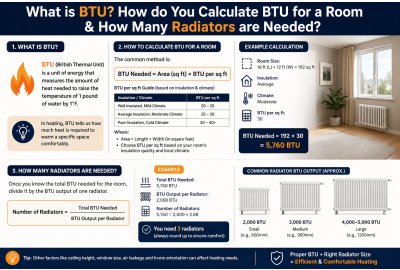
Calculating accurate British Thermal Units (BTUs) is the best way to ensure you have the most efficient heating system, based on the correct number of radiators for your space. We will help you decide what a good BTU for a radiator is and generally give you the low-down on BTU how to calculate. Learning how to calculate BTU correctly will save time and money and keep your home warm. Read on to find out exactly what a BTU is and how it affects your energy bills.
What is BTU?
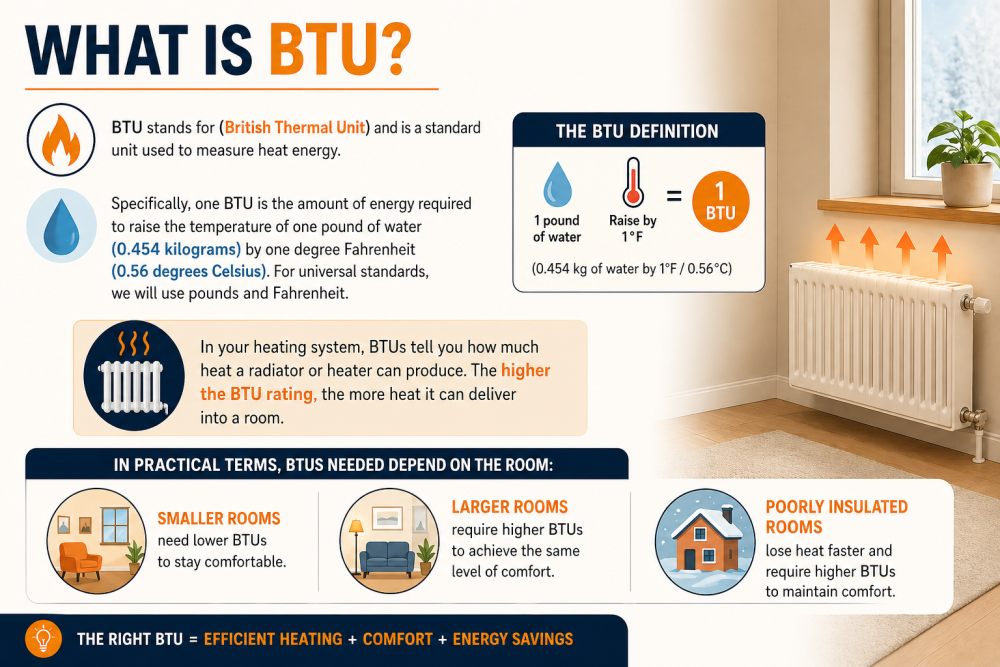
BTU stands for (British Thermal Unit) and is a standard unit used to measure heat energy. Specifically, one BTU is the amount of energy required to raise the temperature of one pound of water (0.454 kilograms) by one degree Fahrenheit (0.56 degrees Celsius). For universal standards, we will use pounds and Fahrenheit. In your heating system, BTUs tell you how much heat a radiator or heater can produce. The higher the BTU rating, the more heat it can deliver into a room. In practical terms, smaller rooms need lower BTUs, and large or poorly insulated rooms require a higher BTU to create the same level of comfort.
BTU how to calculate
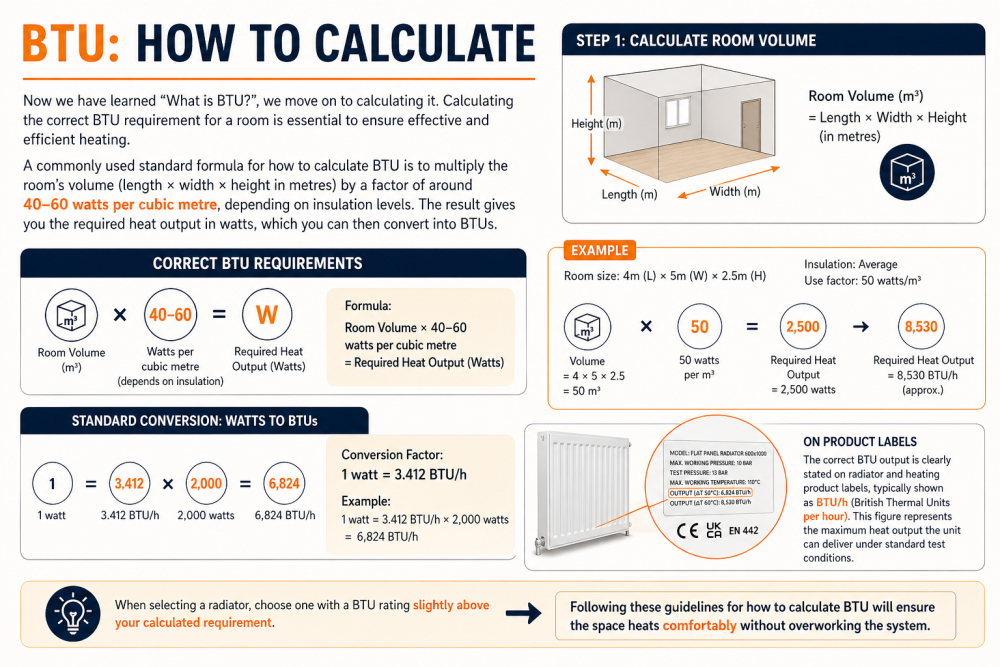
Now we have learned “What is BTU?”, we move on to calculating it. Calculating the correct BTU requirement for a room is essential to ensure effective and efficient heating. A commonly used standard formula for how to calculate BTU is to multiply the room’s volume (length × width × height in metres) by a factor of around 40–60 watts per cubic metre, depending on insulation levels. The result gives you the required heat output in watts, which you can then convert into BTUs.
• Correct BTU requirements - room volume x 40-60 watts per cubic metre = required heat output
To convert watts to BTUs, use the standard conversion factor: 1 watt = 3.412 BTU/h. For example, a room requiring 2,000 watts of heat would need approximately 6,824 BTU/h. The formula allows you to compare calculated requirements directly with radiator specifications, which are often listed in BTUs.
• Standard conversion example - 1 watt = 3.412 BTU/h x 2k watts = 6,824 BTU/h
The correct BTU output is clearly stated on radiator and heating product labels, typically shown as BTU/h (British Thermal Units per hour). This figure represents the maximum heat output the unit can deliver under standard test conditions. When selecting a radiator, choose one with a BTU rating slightly above your calculated requirement. Following these guidelines for how to calculate BTU will ensure the space heats comfortably without overworking the system.
Measure your room - dimensions, ceiling height and window area
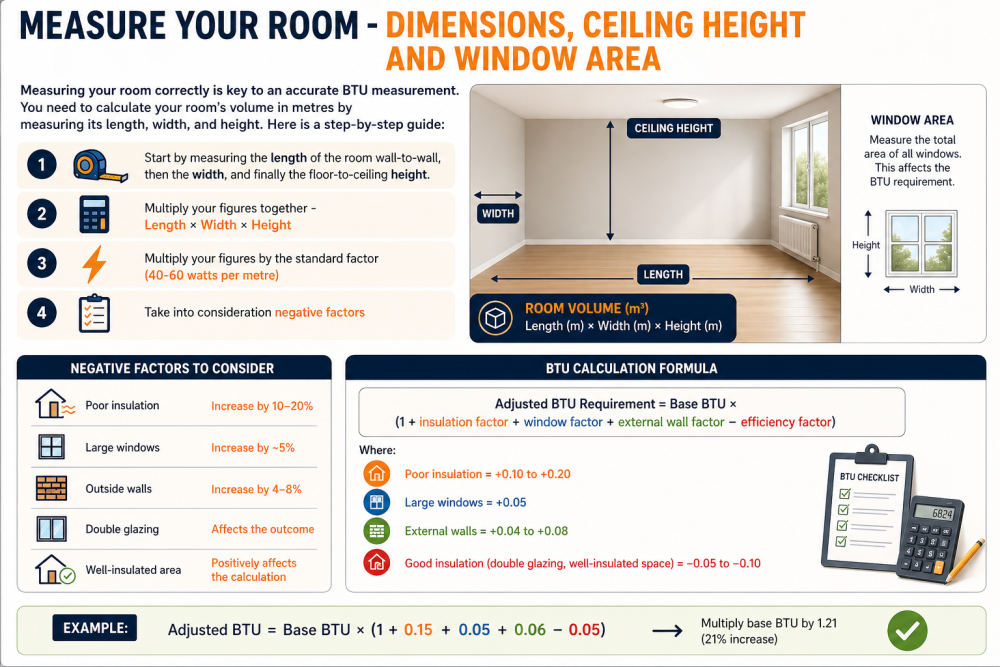
Measuring your room correctly is key to an accurate BTU measurement. You need to calculate your room’s volume in metres by measuring its length, width, and height. Here is a step-by-step guide:
• Start by measuring the length of the room wall-to-wall, then the width, and finally the floor-to-ceiling height
• Multiply your figures together - Length × Width × Height
• Multiply your figures by the standard factor (40-60 watts per metre)
• Take into consideration negative factors
Negative factors to consider are poor insulation (increase by 10-20%). Large windows require a slightly higher percentage allocation (an increase of 5%), and double glazing also affects the outcome. Outside walls require a slightly higher percentage allocation (4-8% increase). Finally, a well-insulated area positively affects the calculation.
For those who want to see a formula. Adjusted BTU Requirement = Base BTU × (1 + insulation factor + window factor + external wall factor − efficiency factor)
Where:
• Poor insulation = +0.10 to +0.20
• Large windows = +0.05
• External walls = +0.04 to +0.08
• Good insulation (double glazing, well-insulated space) = −0.05 to −0.10
Example: Adjusted BTU = Base BTU × (1 + 0.15 + 0.05 + 0.06 − 0.05)
Factors that affect BTU requirement - Heat loss and insulation
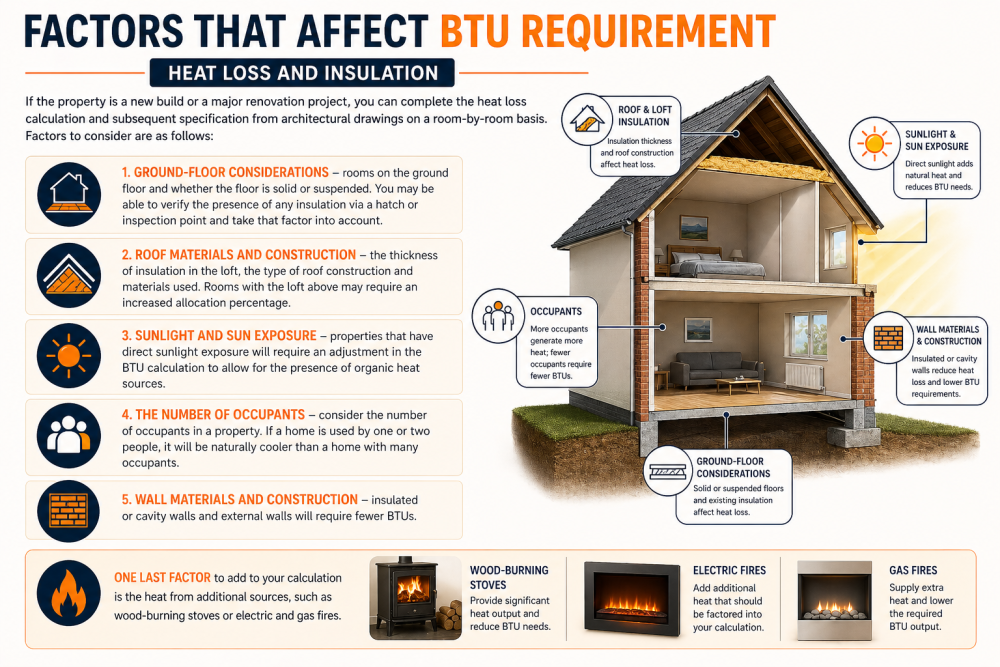
Heat loss and quality insulation affect BTU requirements. The biggest challenges with heat loss calculations for heating systems are not the method of calculation (see the formula noted above) but the number of variables involved. Factors such as thermal bridging and airtightness, along with in-situ U-values, can vary, which has a significant impact. The process can be further hindered by unknown material characteristics, unusual construction techniques, poor-quality building work, natural and unnatural degradation, and unrecorded alterations.
If the property is a new build or a major renovation project, you can complete the heat loss calculation and subsequent specification from architectural drawings on a room-by-room basis. Factors to consider are as follows:
• Ground-floor considerations - rooms on the ground floor and whether the floor is solid or suspended. You may be able to verify the presence of any insulation via a hatch or inspection point and take that factor into account
• Roof materials and construction - the thickness of insulation in the loft, the type of roof construction and materials used. Rooms with the loft above may require an increased allocation percentage
• Sunlight and sun exposure – properties that have direct sunlight exposure will require an adjustment in the BTU calculation to allow for the presence of organic heat sources
• The number of occupants – consider the number of occupants in a property. If a home is used by one or two people, it will be naturally cooler than a home with many occupants
• Wall materials and construction – insulated or cavity walls and external walls will require fewer BTUs
One last factor to add to your calculation is the heat from additional sources, such as wood-burning stoves or electric and gas fires.
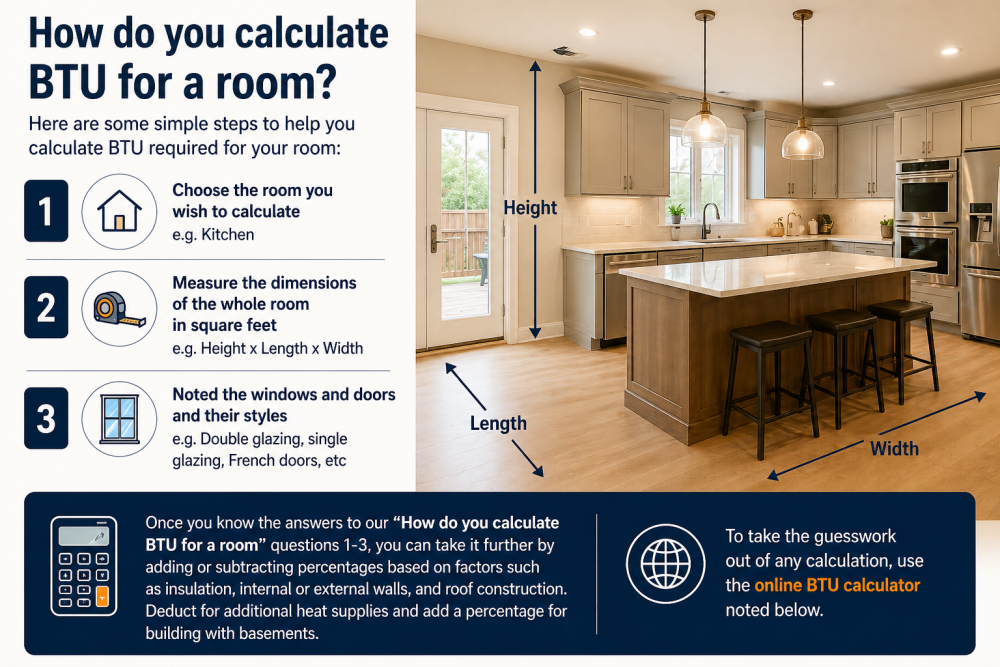
How do you calculate BTU for a room?
Here are some simple steps to help you calculate BTU required for your room:
1. Choose the room you wish to calculate, e.g. Kitchen
2. Measure the dimensions of the whole room in square feet, e.g. Height x Length x Width
3. Noted the windows and doors and their styles, e.g. Double glazing, single glazing, French doors, etc
Once you know the answers to our “How do you calculate BTU for a room” questions 1-3, you can take it further by adding or subtracting percentages based on factors such as insulation, internal or external walls, and roof construction. Deduct for additional heat supplies and add a percentage for building with basements. To take the guesswork out of any calculation, use the online BTU calculator noted below.
What is a good BTU for a radiator?
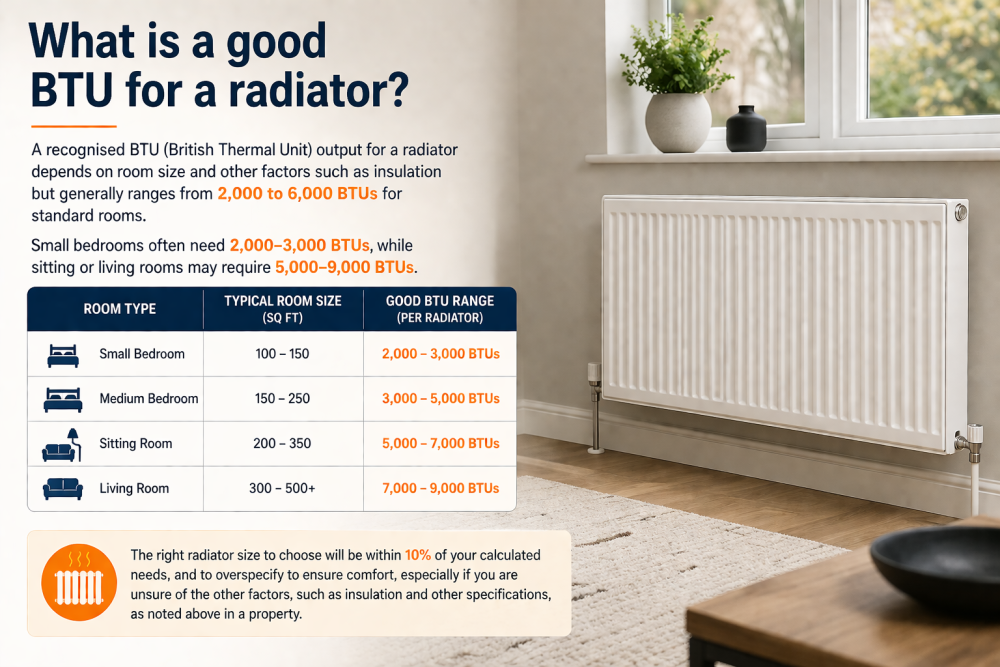
A recognised BTU (British Thermal Unit) output for a radiator depends on room size and other factors such as insulation but generally ranges from 2,000 to 6,000 BTUs for standard rooms. Small bedrooms often need 2,000–3,000 BTUs, while sitting or living rooms may require 5,000–9,000 BTUs.
The right radiator size to choose will be within 10% of your calculated needs, and to overspecify to ensure comfort, especially if you are unsure of the other factors, such as insulation and other specifications, as noted above in a property.
Here are three examples of radiators available from Plumbing World with their BTU rating:
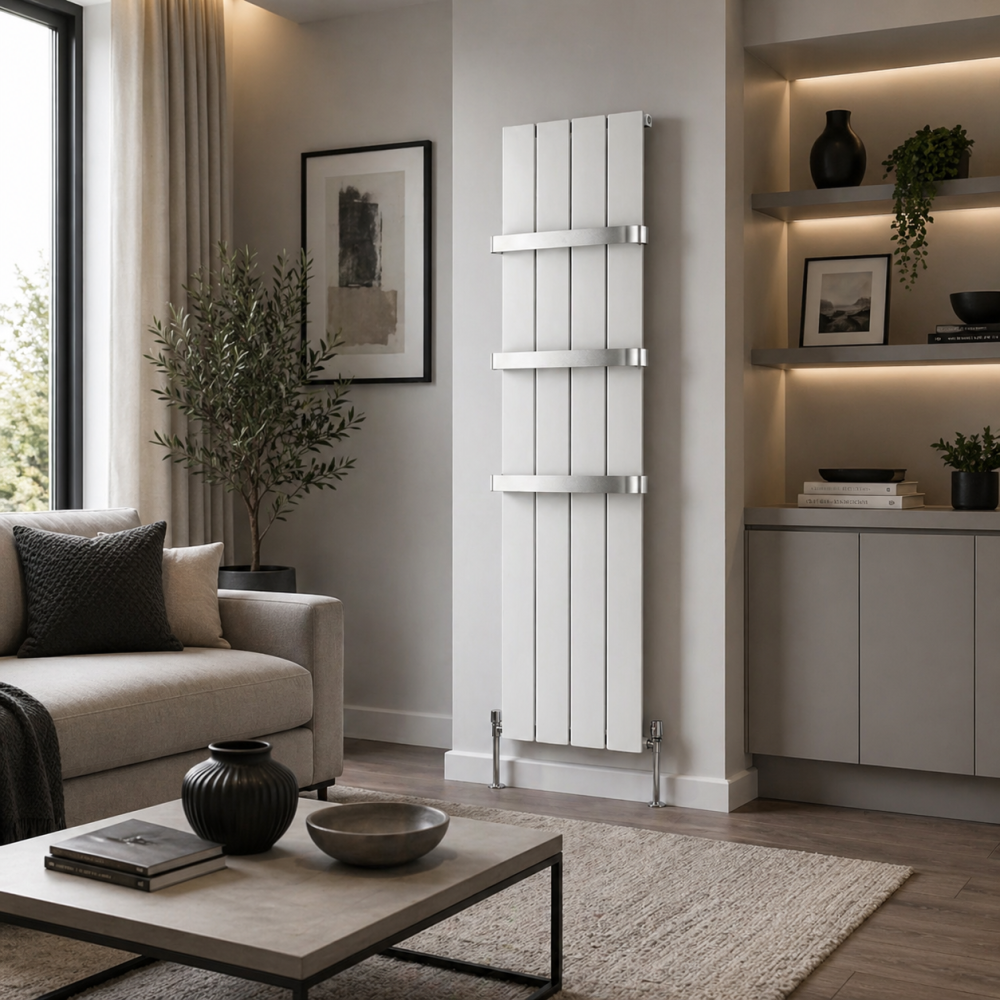
1) Eastbrook Malmesbury 1800mm x 185mm Aluminium Vertical Radiator - Matt White – 1,841 BTUs
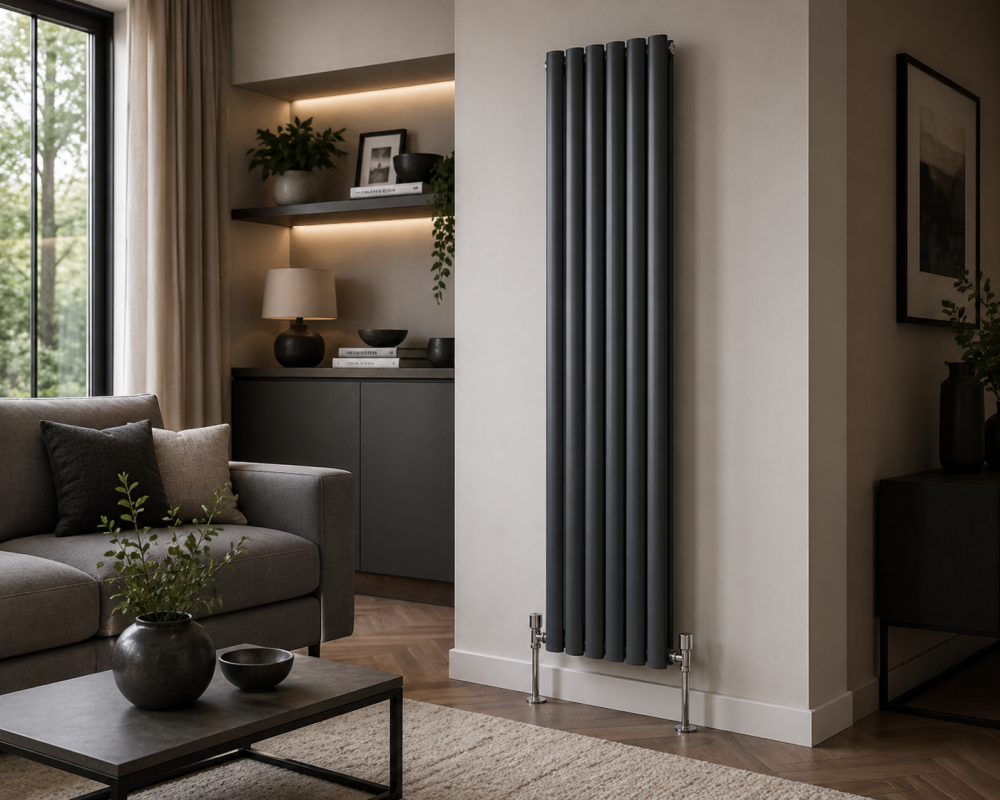
2) Demir Double Vertical Radiator 1600mm x 420mm – Anthracite – 5,004 BTUs
3) Kartell Legacy 4 Column Designer Cast Iron Radiator 760mm x 1260mm - 21 Section – 9,768 BTUs
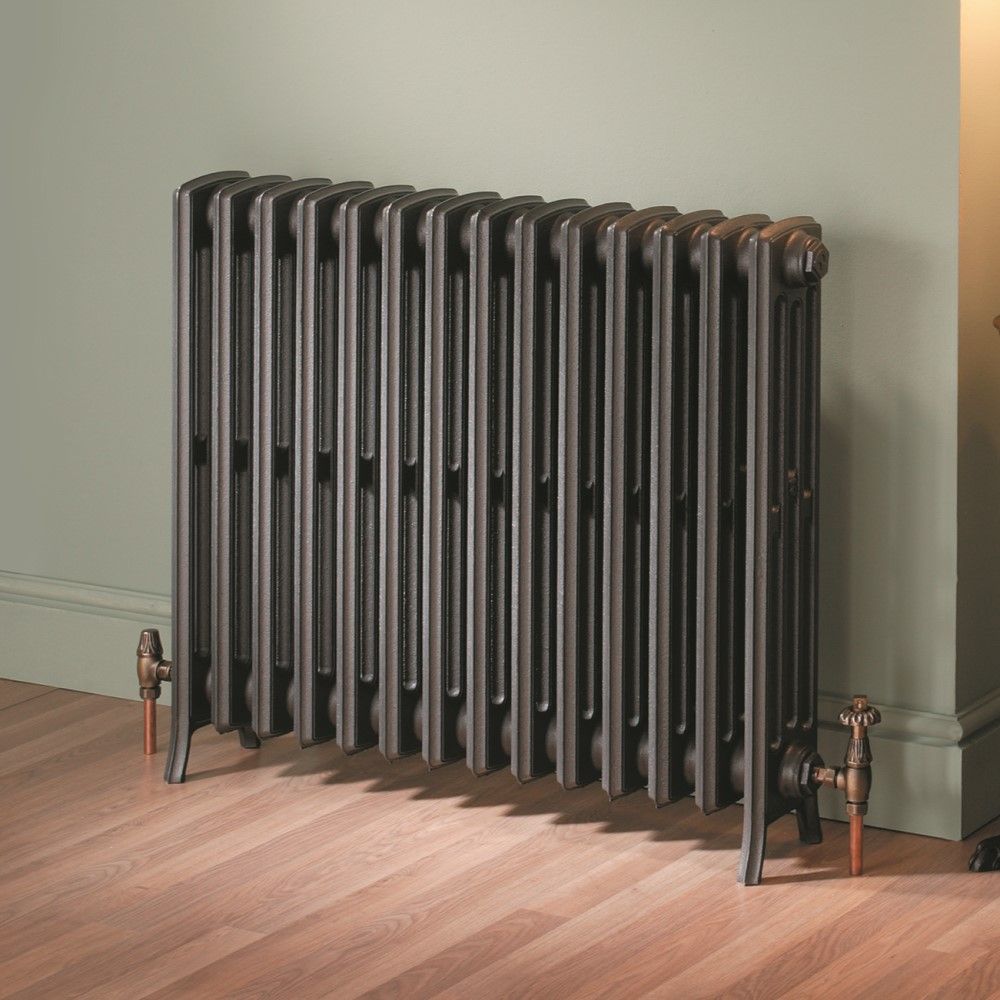
Ultimately, “What is a good BTU for a radiator?”, is dependent on how much BTU you need in a room or area.
Online BTU calculator
Use an online BTU calculator like calculator.net to estimate the needs of a typical room or house. Use this as a general-purpose calculator to help estimate the BTUs required for a comfortable temperature for an area or room. The desired temperature change is the increase in outdoor temperature required to reach the optimal indoor temperature. As an example, an unheated room in London during winter could reach temperatures as low as -2°F. To reach 73°F, an increase of 71°F is required.
The online calculator uses British Thermal Units, or BTU, which, as noted above, is an energy unit. It is the calculation used to determine the energy required to heat 1 pound of water by 1 °F (Fahrenheit) and is equivalent to the energy released by burning a match. 1 watt is approximately 3.412 BTU per hour.
Using an online calculator takes the guesswork out of measuring BTU, which in turn allows the accurate purchasing of heating equipment such as radiators, valves, and boilers.
Common mistakes and troubleshooting for BTU calculation
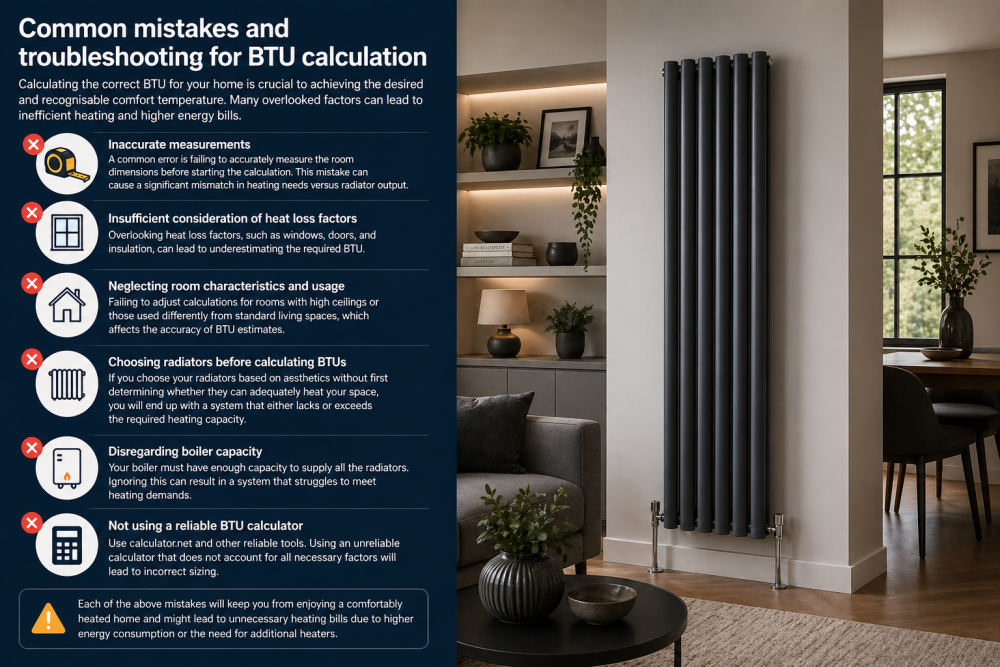
Calculating the correct BTU for your home is crucial to achieving the desired and recognisable comfort temperature. Many overlooked factors can lead to inefficient heating and higher energy bills.
A common error is failing to accurately measure the room dimensions before starting the calculation. This mistake can cause a significant mismatch in heating needs versus radiator output. Overlooking heat loss factors is given Insufficient consideration. Common heat-loss factors, such as windows, doors, and insulation, can lead to underestimating the required BTU.
Neglecting room characteristics and usage results in failing to adjust calculations for rooms with high ceilings or those used differently from standard living spaces, which affects the accuracy of BTU estimates. Choosing your radiators before calculating BTUs is a failure in correct calculations. If you choose your radiators based on aesthetics without first determining whether they can adequately heat your space, you will end up with a system that either lacks or exceeds the required heating capacity.
Disregarding boiler capacity is another mistake. Your boiler must have enough capacity to supply all the radiators. Ignoring this can result in a system that struggles to meet heating demands.
Not using a reliable BTU calculator (Use calculator.net) and instead using an unreliable calculator that does not account for all necessary factors will lead to incorrect sizing. Each of the above mistakes will keep you from enjoying a comfortably heated home and might lead to unnecessary heating bills due to higher energy consumption or the need for additional heaters.
Final thoughts
Choosing the right BTU output ensures consistent room heating while supporting better energy efficiency. Knowing how many BTUs are needed relies on considering room size, insulation levels, and overall heat requirements. Larger rooms, a big window, or more occupants will increase the energy needed for proper heating.
Generally, include a small margin above your calculated output to allow for changing conditions. Requirements will vary based on several factors, including layout, usage, and cooling needs throughout the year. Accurate BTU assessment promotes efficient heating and comfort, avoiding system shortfalls, and a dependable calculator delivers practical and consistent results.
Contact information
Contact Plumbing World in the following ways:
• Calls - 0121 508 9987
• Emails - onlinestore@plumbingworld.co.uk
• More details – click our Contact Us Page
• Live Chat – simply click the blue button at the bottom left of any page