
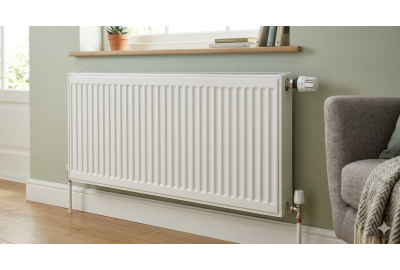
When adding a heating system, the single vs double radiators debate looms large. Whether you should add a single or double radiator will significantly impact the comfort and efficiency of your home heating system. Single and double radiators are two of the most popular options, each offering distinct advantages depending on the space you want to heat. Understanding the difference between them can help you make an informed decision. In this blog, we compare single panel vs double panel radiators to highlight their main benefits and spotlight the differences.
Comparing single vs double radiators
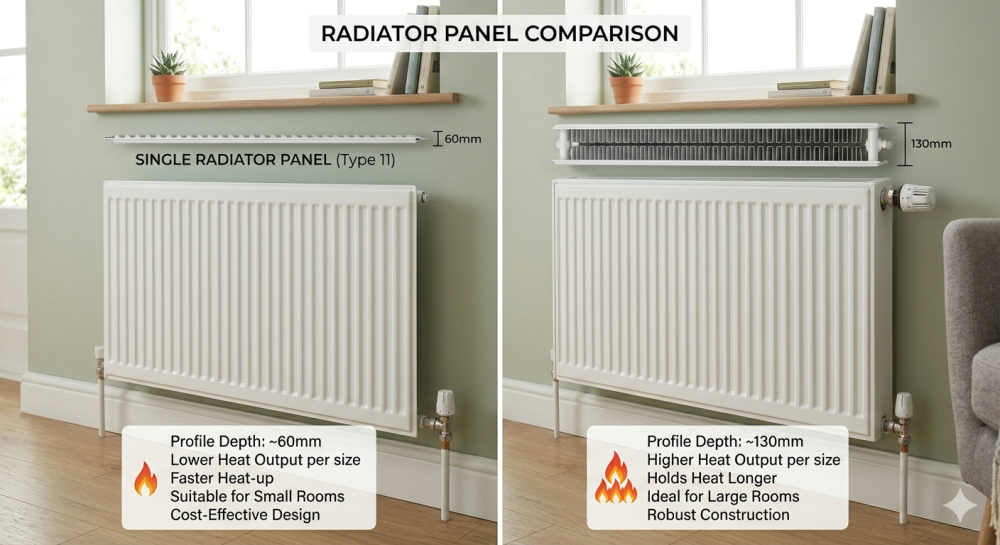
This comparison helps you make the best choice when overhauling your heating system. Read our radiators buying guide for information on this and many other radiator-related topics.
Definitions
• Single radiators – a single radiator is a heat emitter with a single panel of coated metal that transfers thermal energy from hot water to a space via conduction, convection, and/or radiation. Single panel radiators emit lower heat output, making them suitable for smaller spaces with lower heating needs
• Double radiators – a double radiator consists of two coated metal panels (often with fins) that transfer thermal energy from hot water into a room through conduction, convection, and/or radiation. Its multi-layer design increases surface area and heat output, making it suitable for larger spaces that have higher heating needs
Table - single or double radiator?
With so many factors to consider before buying a single or double new radiator, we have put together this table to help you make the best decision.
| Feature | Single radiator | Double radiator |
|---|---|---|
| Aesthetic style | Better for small spaces that need a compact surface area that complements single panel radiator styles | Better for larger spaces that need a bigger surface area that complements double panel radiator styles |
| Compatibility with systems | Compatible with mainstream central heating systems, including combi boilers | Compatible with most mainstream central heating systems; ideal for bigger rooms where higher heat demand is required |
| Depth | Single radiators have a slim, shallow profile that blends into small spaces, promoting efficiency | Double radiators are deeper with more metal in the design due to two panels and convector fins |
| Energy efficiency | Streamlined single radiators offer an efficient heating solution for smaller rooms with a lower heat demand | Due to the double panel design, these radiators are more efficient in larger rooms as they deliver fast double heat output |
| Heat output | Produces less heat energy, measured in BTUs or watts, than double radiator alternatives | Produces more heat energy, measured in BTUs or watts, than single radiator alternatives |
| Installation cost | Generally lower installation cost due to lighter weight and simpler fitting (though not always) | Higher installation costs due to size, weight, and potential bracket upgrades |
| Maintenance access | Easier to access and maintain due to single panel design | More difficult to maintain as it is harder to clean between panels |
| Noise levels | Very quiet; noise usually comes from pipework rather than the radiator | Also very quiet; noise typically originates from pipework, not the radiator |
| Price range | Usually cheaper initially but may cost more if not suited to room size | Slightly higher upfront cost but can be more cost-effective for larger homes |
| Room size suitability | Best for small to medium rooms (e.g. utility rooms) | Best for medium to large spaces |
| Running cost | Lower running costs when used correctly in smaller rooms | More efficient in larger spaces due to better heat distribution |
| Space requirement | Takes up less space due to slimmer design | Requires more space due to increased depth |
| Wall load | Lighter (around 50% lighter like-for-like) | Heavier and requires stronger wall support |
| Warm-up time | Heats up quickly but emits less total heat | Heats up more slowly but retains and emits more heat |
| Weight | Lightweight and easy to install | Heavier due to additional panels and components |
Structural distinction
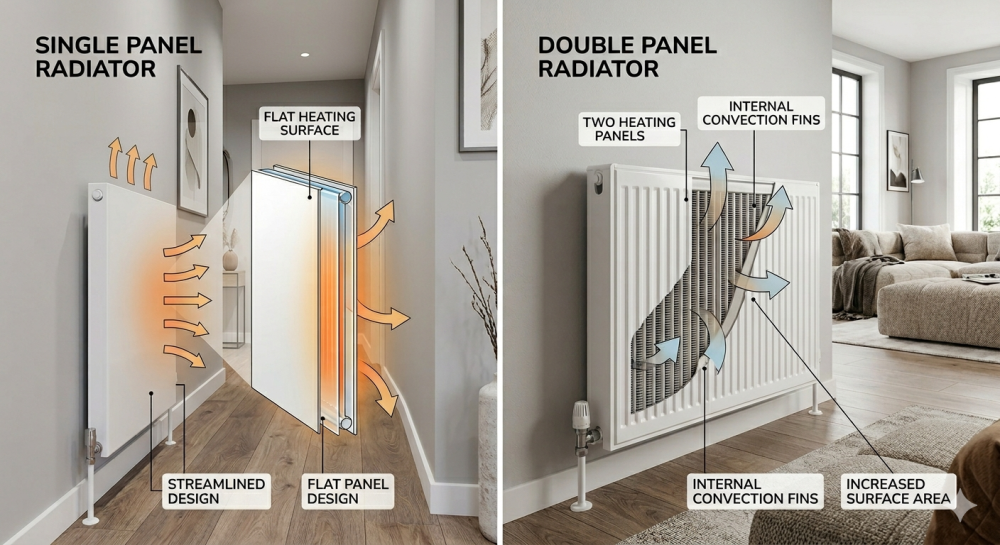
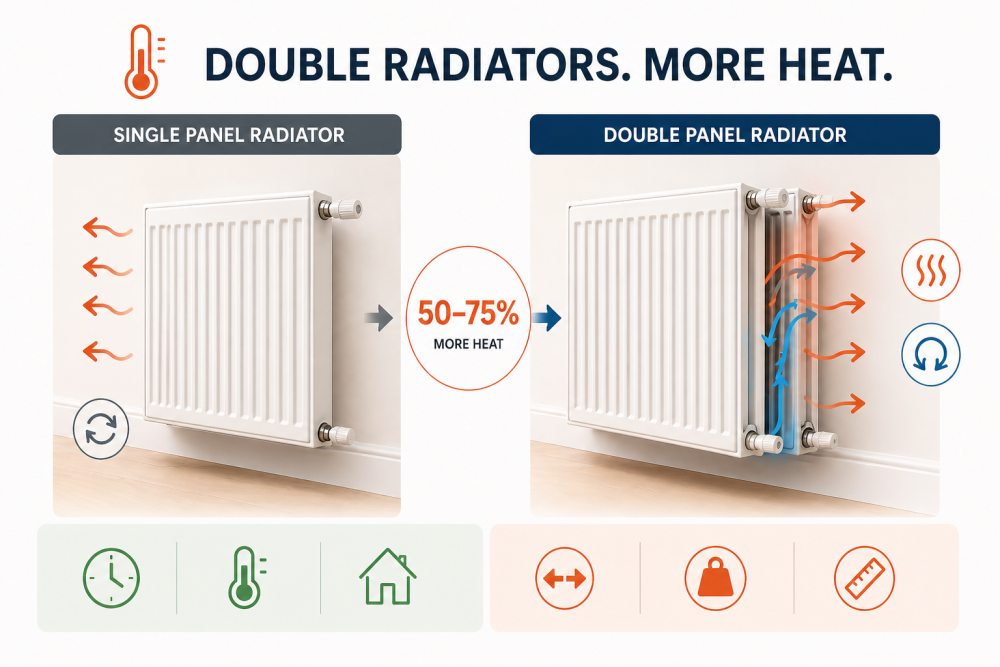
A single panel radiator has one flat heating surface; a double panel radiator design has two panels and convection fins. Highlighting that the difference is often in the design. Single panel radiators are lighter and generally more streamlined, making them easier to install and better suited to tighter spaces.
Double panel radiators, by contrast, are bulkier, bigger and more intrusive but deliver higher heat output due to increased surface area and added convection fins. The additional features make them a practical choice for larger areas or rooms that need more consistent warmth and can sustain significant structural weight.
Typical depth difference
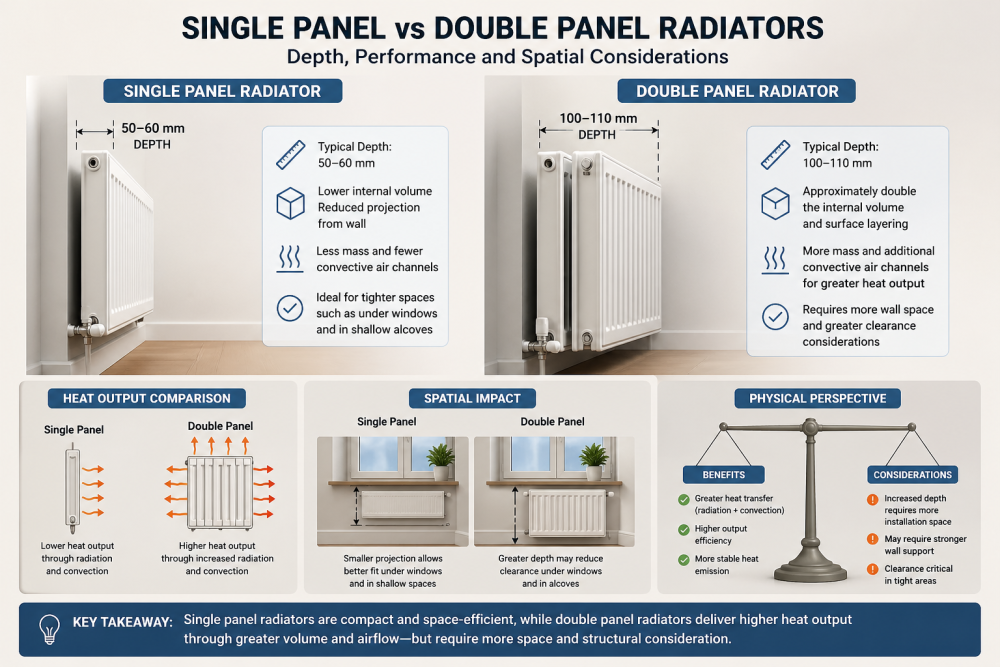
Single panel radiators typically measure around 50–60 mm in depth; therefore, they are lower in overall volume with reduced projection from the wall space. Double panel radiators, at approximately 100 to 110 mm deep, effectively double the internal volume and surface layering, increasing both mass and convective air channels to deliver heat. The added depth alters spatial requirements, particularly under windows and within alcoves, where clearance becomes a critical aspect. From a physical perspective, greater depth increases the radiator’s capacity to transfer heat via both radiation and convection but also requires more installation space and tougher structural considerations.
Type codes explained
Radiator type codes are a standard way to describe your radiator's construction and specify it in short form, such as how many panels and convection fins it has. Whether you have single or double panels, there will be a code. The important part of the code concerns the numbers, e.g., the first number corresponds to the number of panels and the second to the number of convection fins.
Examples are listed below:
• Type 10 single – 1 panel, 0 fins = very slim design with the lowest heat output – Example - Eastbrook Warrington 600mm x 1060mm Type 10 Vertical Radiator - Matt Black
• Type 11 single – 1 panel, 1 set of fins = slim panel with slightly higher heat output – Example - Kartell K-Flat Premium Type 11 600mm x 400mm
• Type 21 double – 2 panels, 1 set of fins = regular-sized double panel giving decent heat output – Example - Eastbrook Type 21 400mm x 1600mm Compact Panel Radiator - Gloss White
• Type 22 double - 2 panels, 2 sets of fins = a double panel with convection fins producing an excellent heat output – Example - Kartell K-Flat Premium Type 22 500mm x 800mm
Practical impact
In practical terms, identical-width double radiator panels typically produce about 50-75% more heat than their single panel design counterparts. The increase is driven by a greater effective surface area and the inclusion of purposeful convection fins. The enhancement of heat transfer through both radiation and convection air flow adds to effectiveness. The additional panel creates more channels for air circulation, accelerating thermal exchange within the surrounding environment. As a result, double radiators can raise room temperatures more quickly while maintaining heat consistently. However, this higher output also comes with increased factors, including depth, mass, and space requirements, which must be considered when installing radiators.
Heat output, BTU requirements and energy efficiency
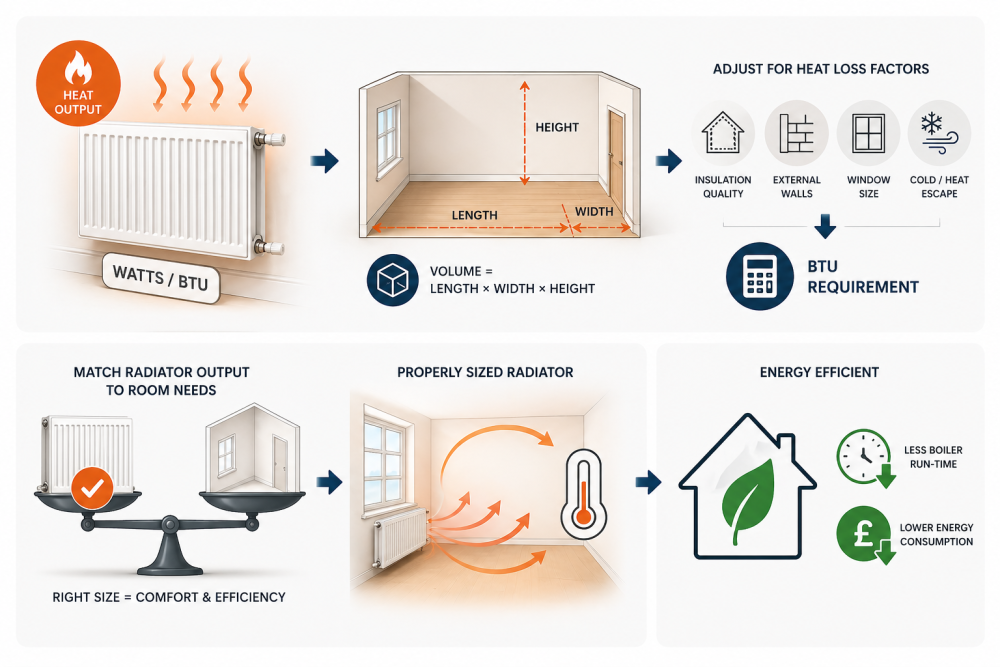
Heat output is specified in watts or BTU (British Thermal Units), with manufacturers listing performance figures for each radiator size and type. The information and values provide a baseline, but actual BTU requirements depend on room volume, insulation quality, the number of external walls, and window size.
Calculating demand typically starts with room/area length × width × height to determine the volume, followed by adjustments for heat loss factors such as poor insulation or heat escape situations, such as large, glazed areas. Using this approach ensures a more accurate match between radiator output and room needs. Energy efficiency is closely linked to correct sizing; a properly specified radiator reaches the desired temperature faster and maintains it with less effort, often reducing boiler run-time and minimising unnecessary energy consumption.
When to choose a single radiator versus a double radiator
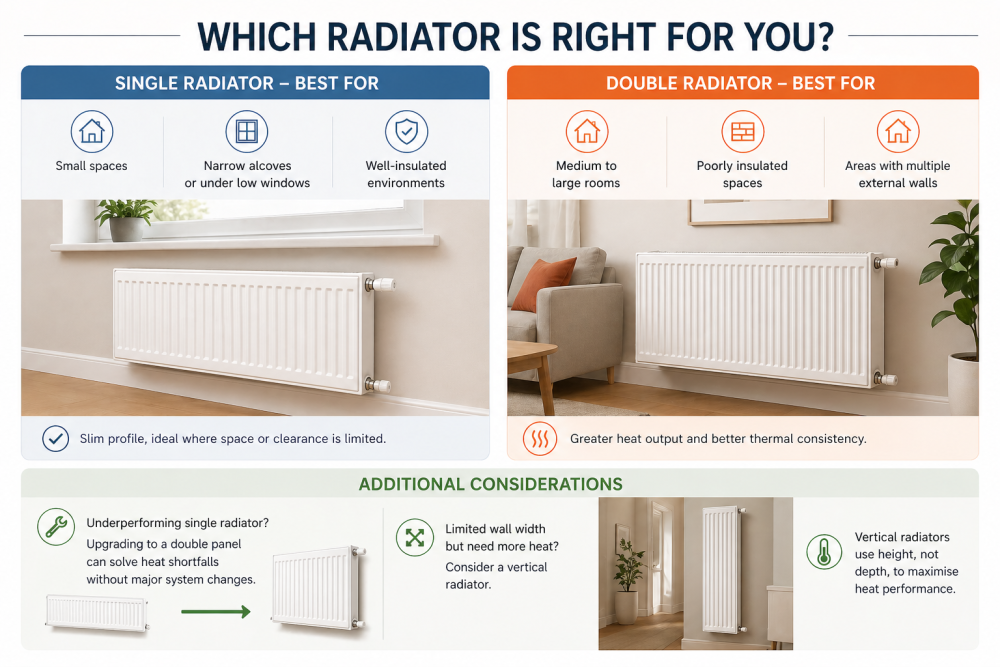
Single panel radiators are best suited to small spaces, narrow alcoves, and areas beneath low windows where additional depth would obstruct functionality or usable space. Single panel slimmer profile makes them practical where clearance is limited, while still providing sufficient heat in well-insulated environments. Double panel radiators are designed for medium through to large rooms, work in poorly insulated spaces (although this is not an environmentally friendly approach), or areas with multiple external walls where the chance of heat loss is higher. The increased surface area and internal convection fins allow double radiators to deliver greater heat output and improved thermal consistency.
An additional point to consider in the single panel vs double panel radiator debate is that if an existing single panel radiator underperforms despite the boiler functioning correctly, upgrading to a double panel model often resolves the heat shortfall without major system changes. Where wall width is restricted, but higher output is still required, vertical radiators offer an effective alternative, utilising height rather than depth to maximise heat performance.
Installation, central heating impact and heating engineer advice
Replacing a single panel radiator with a double unit is generally straightforward, provided the height and width align with existing plumbing, minimising the need for pipework alterations. However, it is not often just a like-for-like swap. A larger radiator increases the system’s total water volume, which can influence boiler flow rates and return temperatures, particularly on older systems. Double panel radiator units are also significantly heavier, so wall integrity matters; always secure into solid masonry or studs or use appropriate heavy-duty anchors to prevent long-term stress on your architecture.
From a system perspective, any upgrade should be followed by proper balancing to ensure even heat distribution across all radiators. It is good practice to consult a registered and qualified heating engineer to assess boiler capacity against the increased BTU (British Thermal Unit) demand, confirm the correct placement of the TRV (thermostatic radiator valve), which regulates room temperature by controlling hot water flow, and make any necessary adjustments for optimal operation.

Radiator types, design and convector radiators explained
We have explained the practical basics of single and double panel radiators. Here, we look at the aesthetics and cover all radiator types.
Convector radiators
Convector radiators use specially designed fins positioned between panels to increase effective surface area and accelerate the convective heat transfer. As air passes over the heated fins, it warms rapidly and circulates around the room or required area, improving heat distribution. The proposed design enhances overall efficiency and allows higher heat output without markedly increasing radiator width. These are available as a single panel convector radiator or as a double.
Designer radiators
Designer radiators are available in both single and double-panel formats, combining aesthetics with practical heat output. They prioritise visual appeal, offering sleek finishes, vertical designs, and statement styles that complement modern interiors. While decorative, they still deliver reliable performance, striking a balance between form and function in spaces that require a design-based touch.
Column radiator
Column radiators offer high surface area per unit depth and can match or exceed panel outputs in many sizes. They heat through a larger exposed surface area, producing strong radiant and convective warmth. Column designs can be wall-mounted or floor-standing, offering flexible placement for period-style or contemporary interiors. Manufacturers note that surfaces run hotter than some panels do; consider low-surface-temperature options for homes with children or other vulnerable occupants.
Mixing single and double radiators across your home
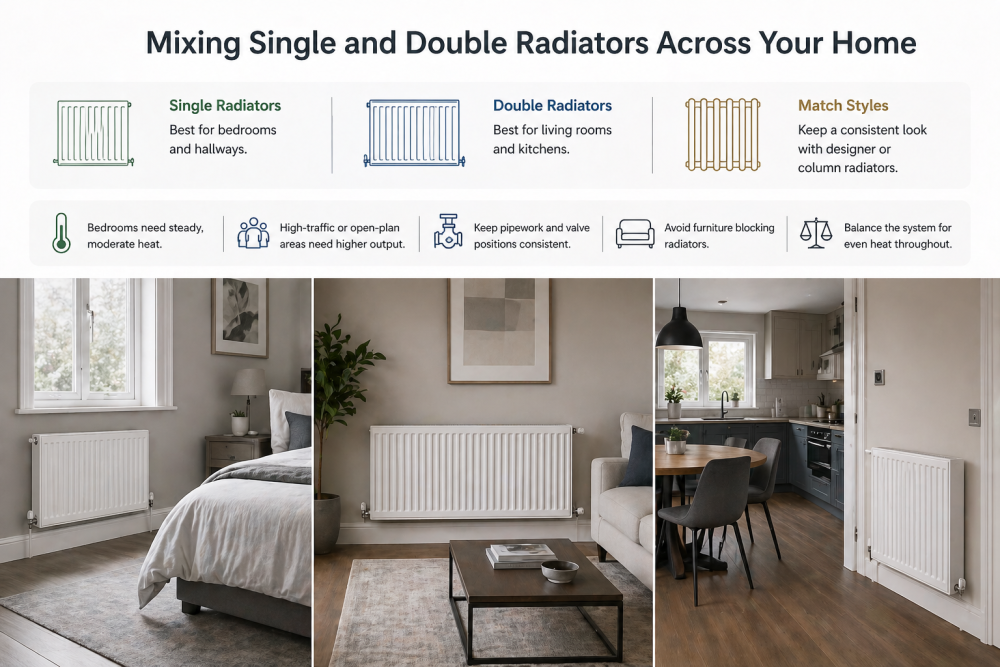
Many homes benefit from a mix of radiator sizes. As a rule, single radiators are for bedrooms and hallways, and doubles for living rooms and kitchens (but not always). Prioritise matching visual styles so that designer radiators or column pieces maintain a cohesive room aesthetic.
From a practical standpoint, consider how each space is used day to day. Bedrooms typically require steady, moderate heat, making single panels sufficient, while high-traffic or open-plan areas benefit from the higher output of doubles.
Keep pipework and valve positions consistent where possible to simplify installation and future maintenance. Also, think about furniture placement, ensuring radiators are not obstructed, as this reduces efficiency. Balancing the system after installation is essential to ensure that each radiator, whether single or double, performs optimally and avoids hot or cold spots throughout the space.
Practical BTU examples and sizing checklist
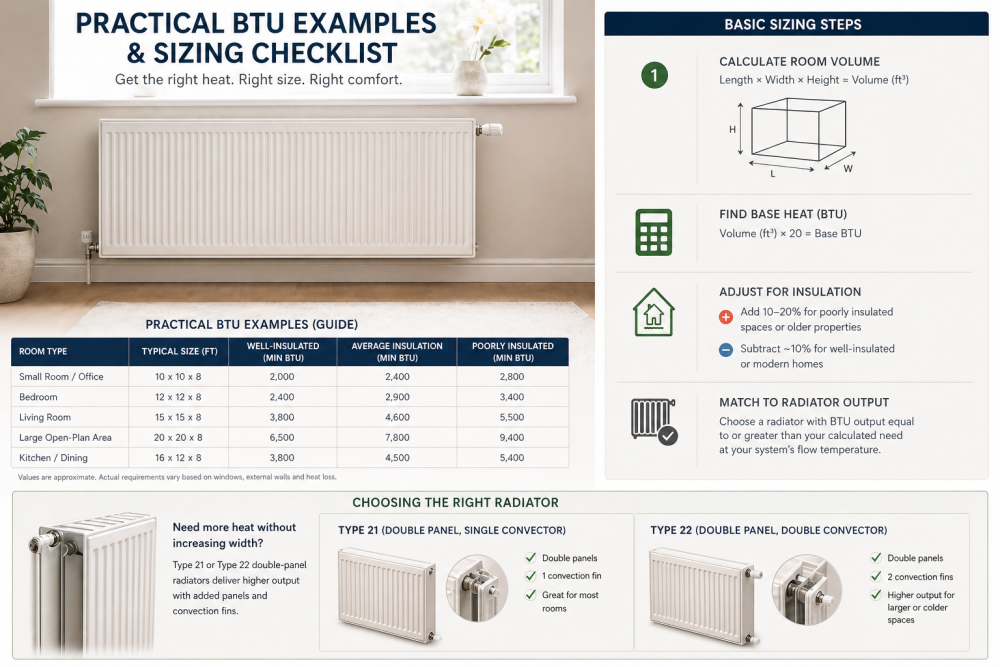
Understanding practical BTU examples and basic sizing can help you purchase the best single- or double radiator units for your home or business.
Basic sizing
Basic radiator sizing starts by calculating the room volume (length × width × height) to determine the base heat (room's BTU) requirement. From there, adjust for insulation: add 10–20% for poorly insulated spaces or older properties, and subtract around 10% for well-insulated or modern homes. These calculations aim to ensure the output reflects real-world heat-loss conditions rather than ideal scenarios.
When comparing radiator models, always match the required British Thermal Units to the manufacturer’s stated output at your system’s central heating flow temperature, as performance varies with operating conditions. For spaces that need large heat output without increasing radiator width, Type 21 or Type 22 double-panel radiators are often the most practical solution, delivering greater performance through additional panels and convection fins.
Conclusion
When choosing a heating system, deciding between single and double radiators is a vital decision. Single panel radiators consist of one metal panel, emitting lower heat, ideal for limited or well-insulated spaces, offering a slim profile, less complicated maintenance, and lower installation costs. Double panel radiators feature two panels and convection fins. They deliver higher heat output, ideal for larger or poorly insulated rooms, while demanding greater depth, reinforced wall support, and higher initial expenditure.
Heat output is measured in BTUs or watts, with sizing dependent on room volume, insulation, and heat loss. Mixing single and double radiators across a home optimises comfort whilst preserving visual cohesion. Proper installation, balancing, and professional heating engineer input guarantee an effective installation.
Contact us
Are you concerned about issues like wasting energy, limited wall space, whether you need multiple radiators and available topics? If so, our friendly team has heating specialist expertise and can advise on the perfect energy-efficient radiator set-up for your home or business.
Our contact information details are:
• Phone us - 0121 508 9987
• Email us - onlinestore@plumbingworld.co.uk
• Full contact details – are available at our Contact Us Page
• Live Chat – simply click on the blue button at the bottom left of any page