
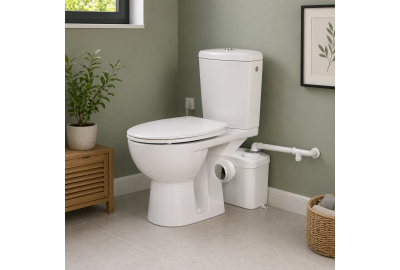
We often get asked, “What is a macerator?” The simple answer is that it solves the allocation problem: a macerator lets you install a toilet where there is not suitable plumbing to connect a regular toilet. So, it could be the key to adding an en-suite to your home or a basement cloakroom.
Most ordinary toilets must be positioned close to your property's main soil and vent stack, the vertical downpipe through which grey and brown waste leave the house and enter the sewer. According to building regulations, this is 6m. Waste pipes generally rely on gravity to carry the flushed waste materials down and away into the sewer or septic system. That is not going to be possible if you want a toilet in an unusual place, such as a basement, away from the main soil stack. If options are limited or are too expensive, that is where macerators come in.
What is a macerator?
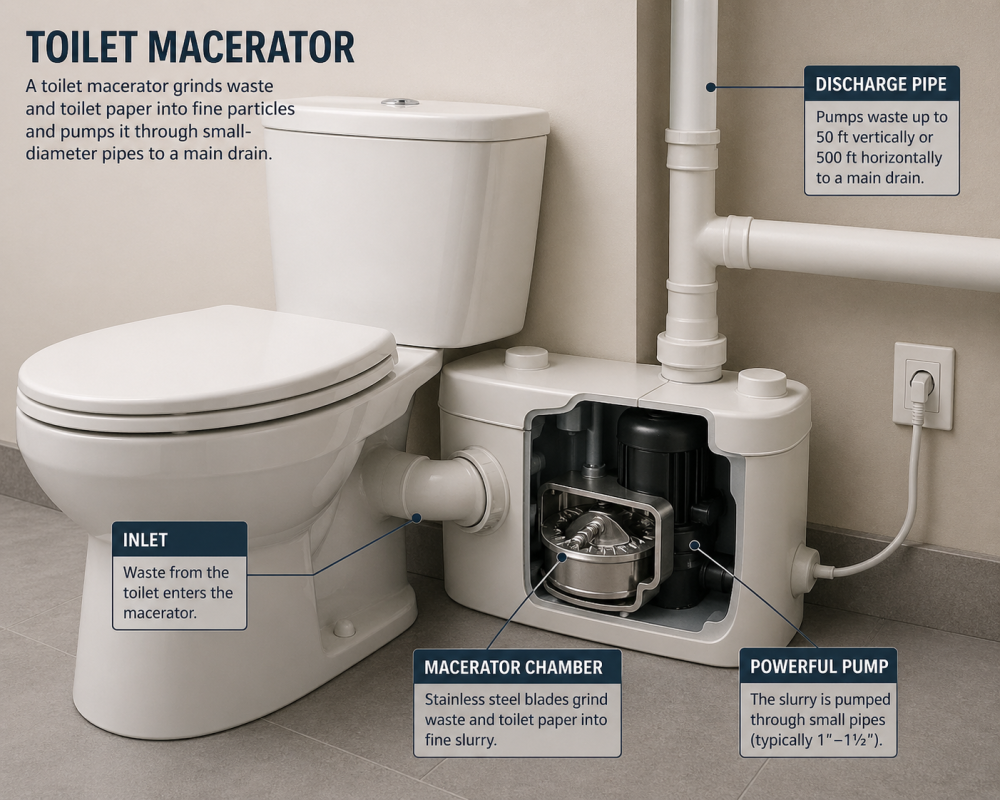
A macerator is a machine that sits behind a conventional toilet. Macerator systems contain a motor that drives a shredder and a pump when the toilet is flushed. The macerator contains shredder blades that blitz the waste with water, forming a liquid. From there, the pump flushes that liquid away. Because of the pressure provided by the pump and the fact that the waste is now this liquid, it can be pumped through narrower pipes (about 3cm, much narrower than standard waste pipes) for longer distances before reaching the soil stack and discharging into the main sewer line. Meaning you can locate your toilet in convenient places for you that normal plumbing would find difficult to service.
Related terms
There are many descriptions to describe the same process, for instance, we can refer to a toilet with a macerator and look for the best macerating toilet with an efficient macerator pump. All these terms refer to the machinery that allows you to install a toilet where it would normally be considered a plumbing impossibility.
Macerator pump
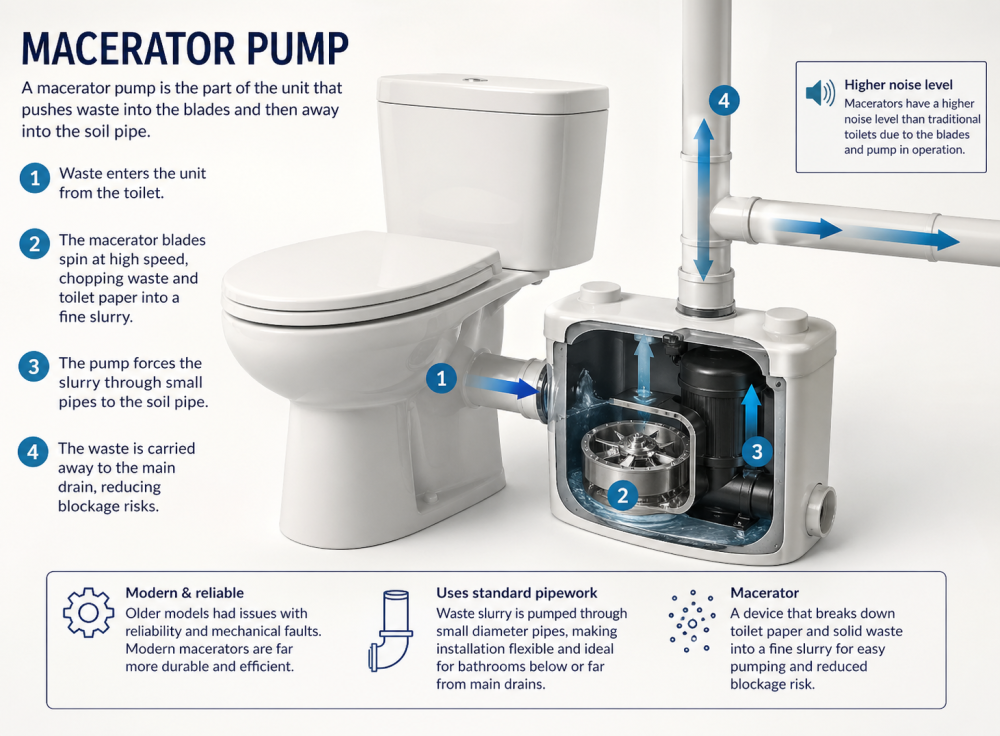
A macerator pump is the part of the unit that pushes waste into the blades and then away into the soil pipe. To go one step further, a macerator is a device typically used in plumbing to break down toilet paper and solid waste into a fine slurry. For this reason, macerators have a higher noise level than traditional toilets. Once broken down, the waste slurry can then be pumped away via standard pipework, reducing blockage risks and making it an essential component in many modern plumbing systems. Older models were commonly associated with reduced reliability and an increased incidence of mechanical issues.
Macerator toilet
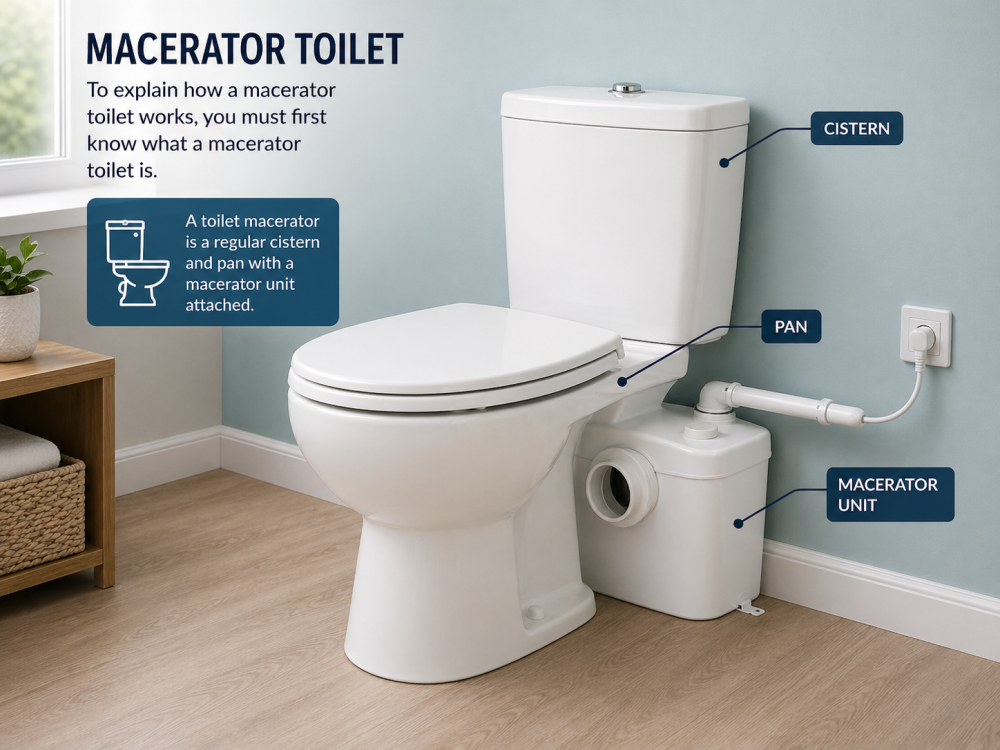
To explain how a macerator toilet works, you must first know what a macerator toilet is. A toilet macerator is a regular cistern and pan with a macerator unit attached.
How does a macerator toilet work?
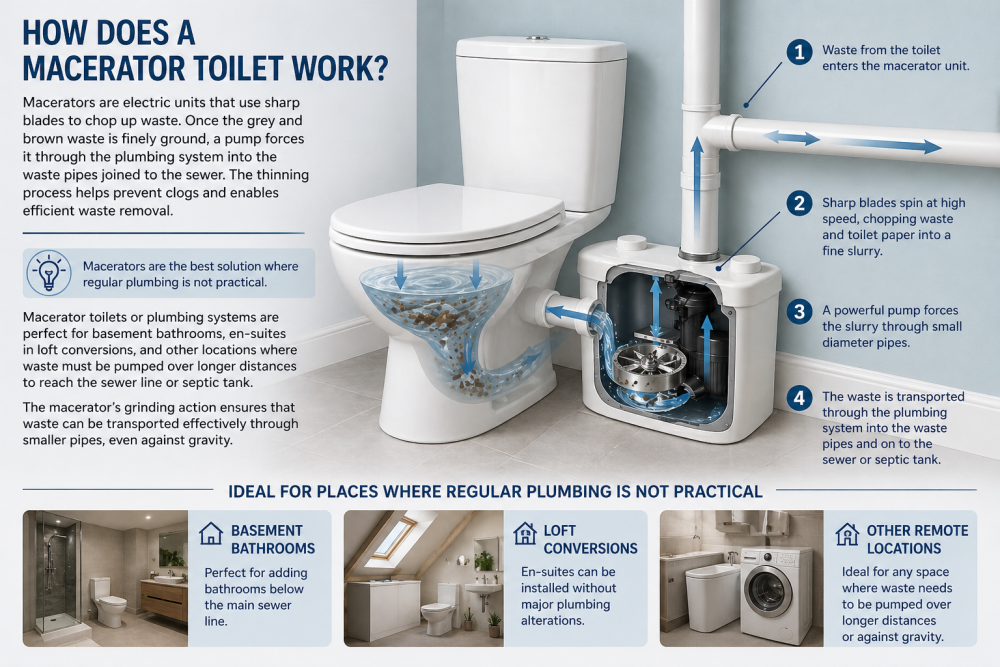
Macerators are electric units that use sharp blades to chop up waste. Once the grey and brown waste is finely ground, a pump forces it through the plumbing system into the waste pipes joined to the sewer. The thinning process helps prevent clogs and enables efficient waste removal.
Macerators are the best solution where regular plumbing is not practical. Macerator toilets or plumbing systems are perfect for basement bathrooms, en-suites in loft conversions, and other locations where waste must be pumped over longer distances to reach the sewer line or septic tank. The macerator’s grinding action ensures that waste can be transported effectively through smaller pipes, even against gravity.
What is a Saniflo system?
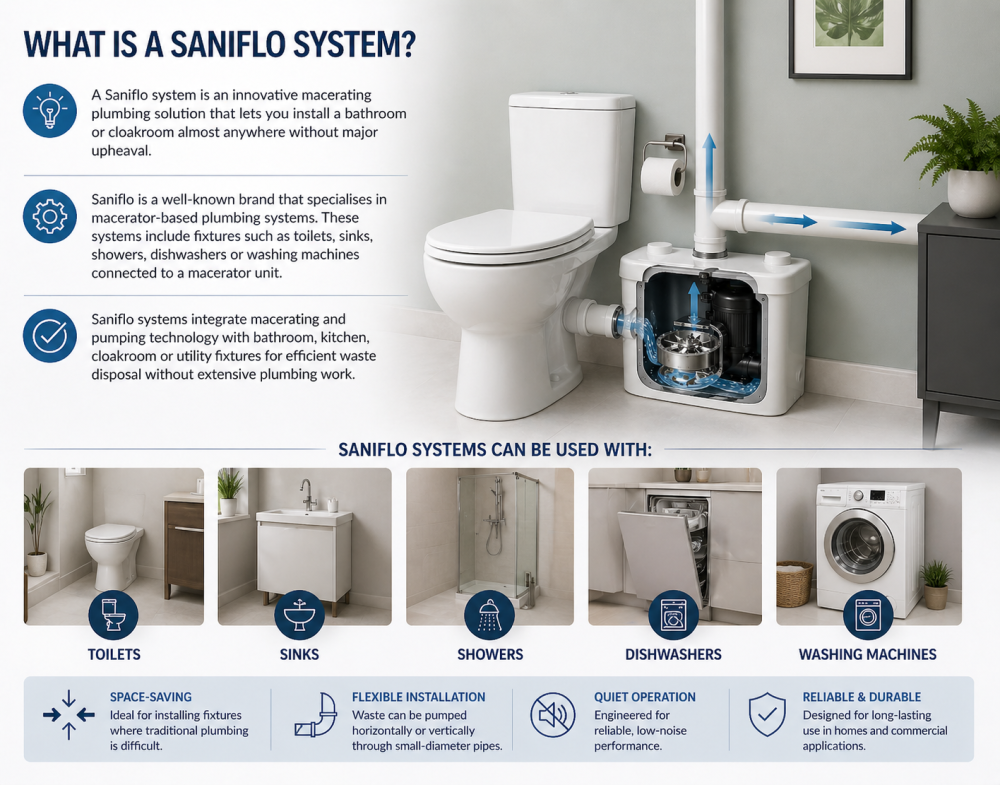
When asking, “What is a Saniflo system?” the answer is not as complicated as it might seem. A Saniflo system is an innovative macerating plumbing solutions that enable you to install a bathroom or cloakroom almost anywhere without major upheaval. Saniflo is a brand name and is synonymous with replacing traditional plumbing, which can be difficult or expensive to install.
Saniflo is a well-known brand that specialises in macerator-based plumbing systems. When people refer to a “Saniflo system,” they typically mean a plumbing setup that incorporates a macerator unit. These branded systems are designed for residential and commercial applications and are known for their space-saving design. The wider systems typically include a toilet, sink, or other fixtures (such as a dishwasher or washing machine) connected to a macerator unit.
A Saniflo system can be more effective than other brands and integrates the macerator’s grinding and pumping capabilities with the fixtures in a bathroom, kitchen, cloakroom or utility. The system enables efficient waste disposal without the need for extensive plumbing work.
Features to expect from a best macerating toilet
When purchasing a macerating toilet, take note of the following features as they make a difference to the efficiency of your unit.
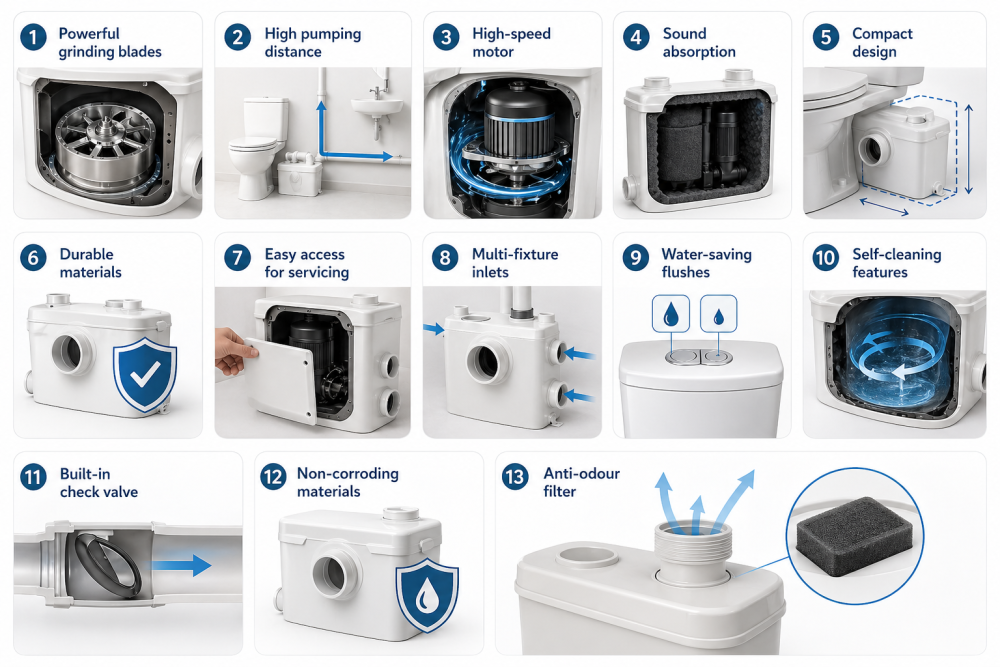
1) Powerful grinding blades
Powerful grinding blades are vital to your macerator's efficiency. The blades are made of hardened stainless steel for strength and durability. They are rust-resistant, which is vital in a wet environment.
2) High pumping distance
‘High pumping distance’ (often mistakenly written as high pumping distance) in a macerator refers to how far the unit can move wastewater vertically and horizontally from the toilet, basin, or shower to the main soil stack or drain.
3) High-speed motor
A high-speed motor refers to a motor operating at high speed. Generally, speeds range from 3,600 to 5,000 rpm. Domestic macerators range from 2,800 to 3,600 rpm. Saniflo units have balanced, durable pumps which work well at domestic speeds.
4) Sound absorption
The best macerators have sound insulation, which allows the machine to operate as quietly as possible. The macerator casing often has insulation to reduce noise during use.
5) Compact design
Macerators are designed to be compact and to fit behind the toilet bowl or behind panelling or casing. For access to the macerator for maintenance, an access panel should always be installed.
6) Durable materials
The entire make-up of a macerator unit, Saniflo or otherwise, is durable. The casing is almost always plastic, and the internal workings are also plastic, with hardened stainless steel blades. All parts of the macerator must be waterproof.
7) Easy access for servicing
If you do not plan for servicing before installation, a macerator will eventually become a nightmare. They will need maintenance at some point, so access is non-optional. Add an access panel so your macerator is always easy to reach.
8) Multi-fixture inlets
Your macerator will always have multi-fixture inlets unless it is specifically designed for only one purpose. A standard macerator will have a large inlet for the toilet and one or two side inlets for the hand basin or shower.
9) Water-saving flushes
Your macerator itself does not control how much water is used. The toilet cistern (flush system) does. The toilet has a flush volume regulator the macerator just deals with the water it is given.
10) Self-cleaning features
This depends on what you call self-cleaning. When you flush, the high-speed blade spins, creating a rinsing or scouring action in the chamber (some higher-end units run an additional rinse cycle after each use), but no macerator has a mechanism that removes limescale, grease buildup, or biofilm.
11) Built-in check valve
Yes, most macerators do have a built-in check valve (non-return valve). The valve prevents wastewater from flowing back into the machine and from the pipework. The built-in valve check keeps the system primed and hygienic.
12) Non-corroding materials
All materials used in a macerator are on-corroding and include plastic and stainless steel fittings designed to work with electricity and water.
13) Anti-odour filter
Some macerators include carbon filters, but most rely on sealed units and proper venting to prevent odours. Regular cleaning and correct installation are more important than having a dedicated filter.
Buying the best macerators at Plumbing World
Now you know the answer to the question, “How does a macerator toilet work?” So, next, you need to know our best three recommendations, and they are as follows:
1) FlowPro FP800 Macerator for Commercial and Heavy Use
Offering the easiest access for servicing/maintenance, an enhanced capacity for an en-suite. With a voice alarm to alert when maintenance is required. The FlowPro FP800 Macerator is suitable for use with toilets, hand-wash basins, showers, and bidets. The FP800 is one of the best macerators for houses in multiple occupation or mixed-use properties (commercial and domestic). Built for heavy use. It has an IPX4 rating that carries a two-year guarantee.
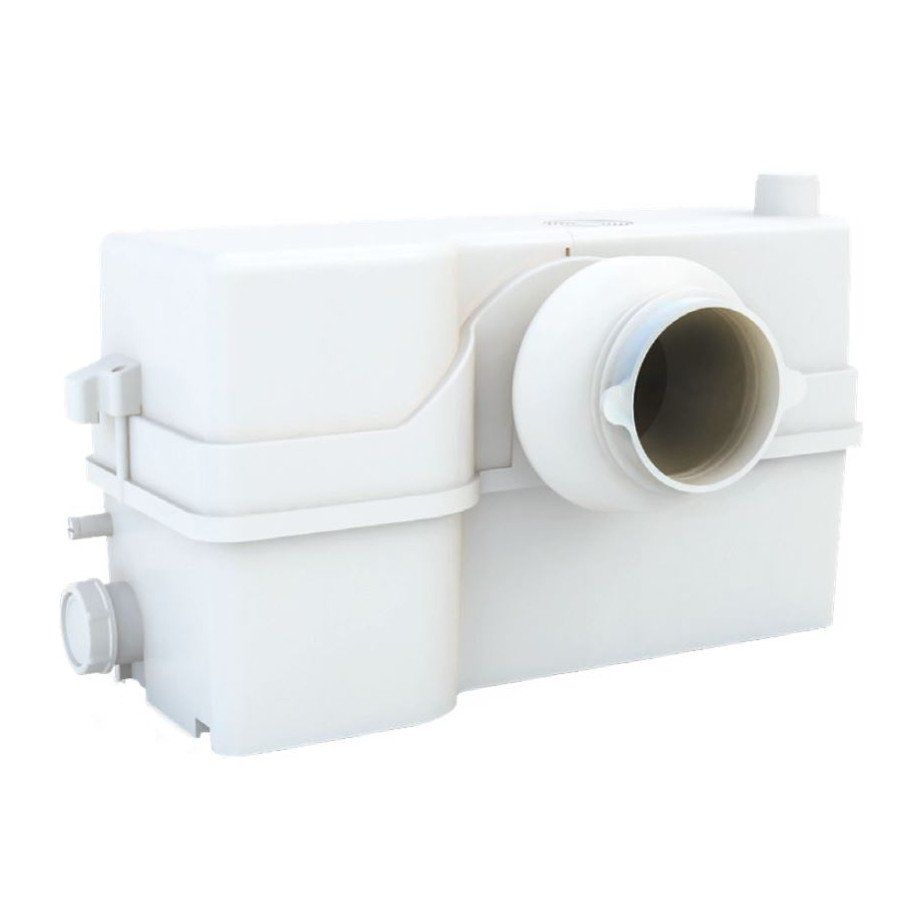
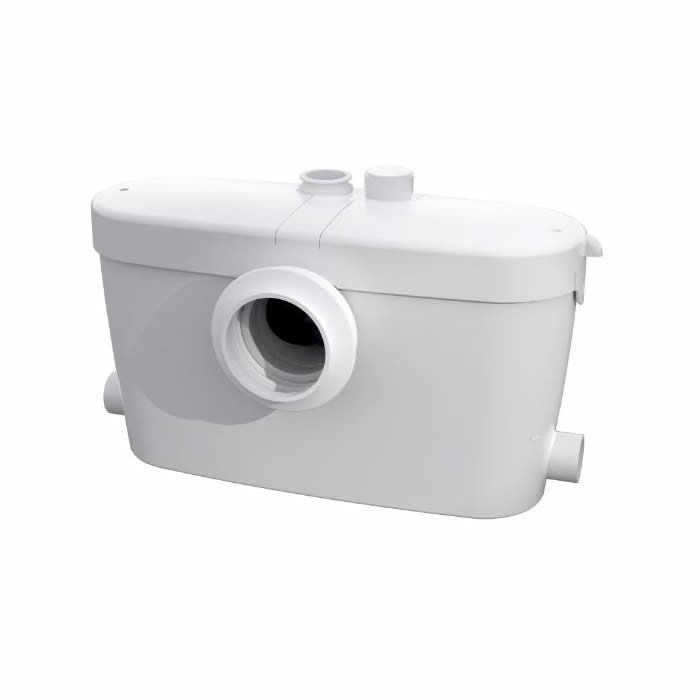
2) Saniaccess 3 Macerator
This macerator is for domestic use and is perfect for bathrooms, with an IP44 rating (an IP44 rating is a standard classification used to define the level of protection an electrical device's enclosure provides against solid objects and liquids). Suitable for new installations. Designed for easy access in en-suite bathroom applications, convenient covers allow you to service and maintain the macerator without removing it. Suitable for fitting with a toilet, basin, shower and bidet. The Saniaccess 3 Macerator offers easy service access and quiet technology. One word of warning: the Saniaccess 3 Macerator is intended for new installations, as its inlet and outlet positions differ from those of other Saniflow units.
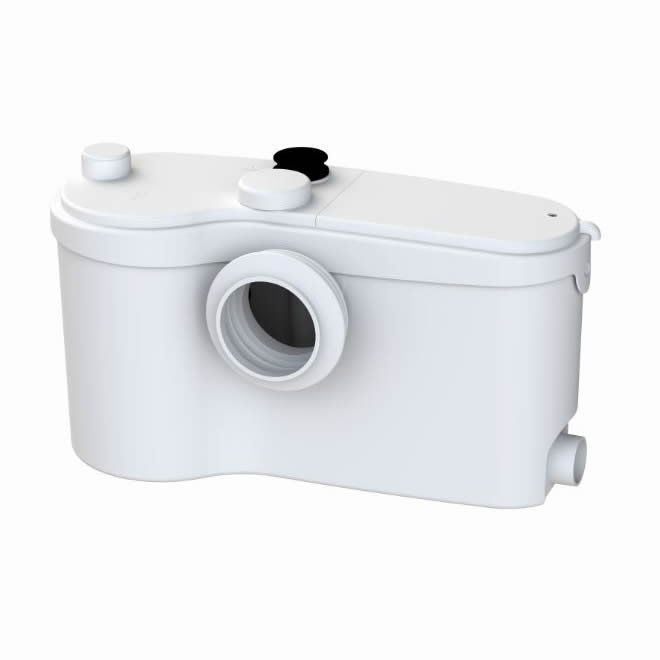
3) Sanibest Pro Heavy-Duty Macerator
This robust macerator is suitable for use in public or commercial settings. The machine handles connections to a WC, basin, bidet, and power shower. The Sanibest Pro heavy-duty macerator is designed for high-usage environments, featuring three inlets (two side entries and one cover entry) for flexible installation. It operates at a working temperature of 35°C, meets the European standard EN 12050-3, and is built to handle the occasional inappropriate item that is flushed down the toilet. It also comes with a 2-year warranty, supported by a nationwide network of service engineers.
Conclusion
A toilet with a macerator is a viable alternative to traditional toilets. One of the primary advantages is that they allow you to have a new bathroom toilet in alternative areas, such as an outdoor building, like sheds or garages. The waste materials are pumped to the sewage system through pipes connected to the macerator, so you are likely to need a plumber for tasks like this. If you want a macerator example, read our three reviews of models available from us.
Contact us
If you have any questions about “What is a macerator?” and their cost, common issues, expected lifespan and which models to choose, why not contact us?
Our contact details are:
• Call us - 0121 508 9987
• Email us - onlinestore@plumbingworld.co.uk
• More details – see our Contact Us Page
• Live Chat – simply click the blue button at the bottom left of any page